Pop culture has one requirement: popularity.
Popular culture refers to ideas and media that most people in a society enjoy or promote. The whole point of art is to be seen by people and provide them with a cathartic response, so the goal of all true art (and not "art for art's sake") is to become popular and seen by more people. In attempts to be more popular, artists tend to create in the vein of either works that inspire the artist or that they know are popular. When several artists in the same place and time start to write in a similar style about similar themes using similar tropes (characters, plots, motifs, and symbols), they create a literary movement.
A literary movement depends upon what ideas are popular at a time. As with all popular culture, overexposure to the same type of idea can make an audience tired and wanting something new; when this happens, and old literary movement dies and a new literary movement, reacting to the old, is born. Literary movements can splinter, coalesce, of even be revived as subgenres.
A literary movement depends upon what ideas are popular at a time. As with all popular culture, overexposure to the same type of idea can make an audience tired and wanting something new; when this happens, and old literary movement dies and a new literary movement, reacting to the old, is born. Literary movements can splinter, coalesce, of even be revived as subgenres.
New literary movements are born from major events,
and become reactions against the old movement.
The following are the major literary movements in the Western literary canon. While each could be broken down into more specific movements and concepts, the movements below should give a brief overview of how literary historians group and classify literature based on its reception and inclusion in the popular culture of the time.
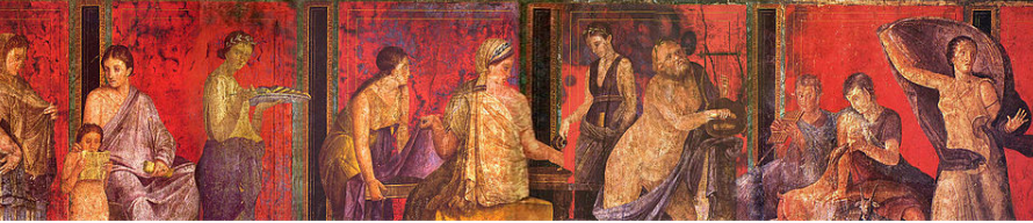
Artist Unknown, Dionysiac Frieze in the Villa of the Mysteries, Pompeii (c. 60 BCE)
CLASSICAL (3000 BCE-600 CE)
The oldest literature appears in the Indus Valley, ancient Greece, ancient Rome, and ancient China. While these texts originated independently in very different cultures, they are all marked by adhering to the Unities: a single time frame, a single place, and a single action (plot). Characters are also all archetypes, and most stories are tied to myth. In every story, gods interact with man and usually enforce fates of characters. Popular writers include Plato, Aristotle, Sophocles, Euripedis, Aristophanes, Ovid, and Virgil.
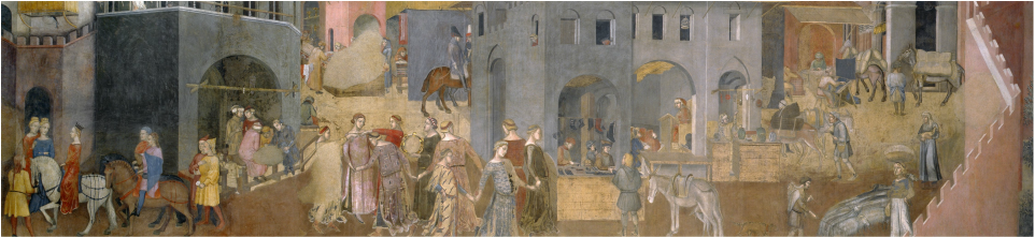
Ambrogio Lorenzetti, The Effects of Good Government (1339)
MEDIEVAL (500-1300)
BORN OF: Christianity becoming the dominant faith in Europe
REACTED AGAINST: Classical polytheism in stories
Medieval writing featured mainly religious stories written by (usually) anonymous authors. These works examine the goodness of man against the suffering of the world and begin to use the elements of style (as written languages, including English, started to have consistent grammar, allowing authors to develop syntactic wordplay and tone). This time is history is marked by feudal lifestyles and grand wars, so most plots and conflicts revolved around dying in glory or accepting one's place in life. Most authors in Medieval times wanted to appear humble, so they submitted work anonymously (and even if they did want people to know of their work, many names were simply lost over time). Theologians on the other hand, like Thomas Aquinas, Peter Abelard, and Maimonides, were often well known for the religious philosophical works they produced. Other important Medieval authors include Rashi and Geoffrey Chaucer.
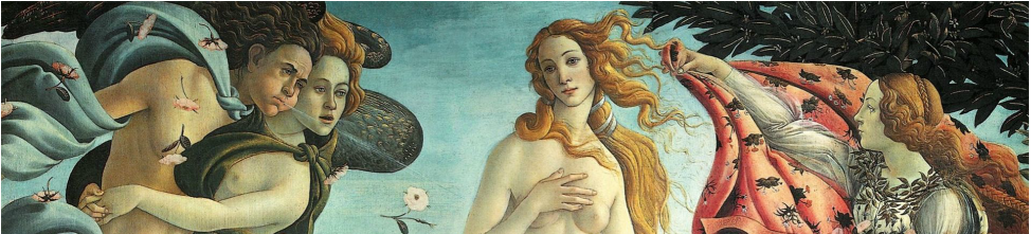
Sandro Botticelli, The Birth of Venus (c. 1480)
RENAISSANCE (1300-1700)
BORN OF: End of crusades and development of widespread literacy
REACTED AGAINST: Moral requirements and character of medieval writing
The Renaissance saw an expansion of writing in native tongues with development of Guttenberg press: suddenly, texts had informal and independent styles. While most Renaissance writing involves the upper class (as the wealthy had the leisure to write), texts began to show the perspective of the common man. As the renaissance introduced the world to the idea of social mobility, conflicts in stories shifted from those involving the gods and fate to those involving self-doubt and societal pressures. During this period, genres were developed, and imagery became well used, as writers wanted a text to reveal inner truth and beauty. Popular Renaissance writers include Dante Alighieri, Petrarch, Thomas Malory, and Niccolo Machiavelli. The Renaissance also saw the rise of submovements, where a specific country or region infused Renaissance writing with their own unique tropes:
- ELIZABETHAN (1558-1611): This was the “Golden Age” of British literature. Queen Elizabeth gave unprecedented patronage to writers and playwrights in order to spread English entertainments and record English history. Popular writers included William Shakespeare, Christopher Marlowe, and Edmund Spenser.
- METAPHYSICAL POETS (1633-1680): After James became king of England, literature began to focus on the wonders of everyday life and the higher meaning and purpose behind life. Most writing of the time has religious allusion--James even had the Bible rewritten and translated (the King James version). British poets adapted to this new style by inventing the use of a conceit, or central metaphor, throughout a poem. Popular metaphysical poets include John Donne, Andrew Marvell, Abraham Cowley, and Anne Bradstreet.
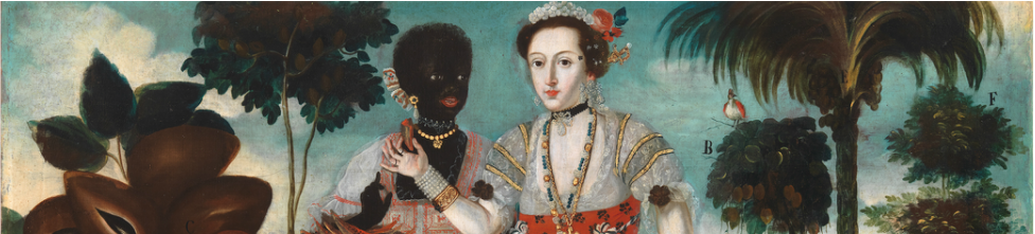
Vicente Albán, Noble Woman With Her Black Slave (c. 1783)
COLONIALISM (1472-1750)
BORN OF: discovery of new world
REACTED AGAINST: European manners and delicacies
In 1492, Columbus' journeys to the New World inspired a rush to the Americans, Sub-Saharan Africa, and the South Pacific, all "unclaimed" lands that inspired exploration and independence. Almost all the native societies of these places did not have a system of writing, yet some of their mythology and stories were recorded and are all that exist of Pre-Colombian literature. Pre-Colombian literature is interesting to analyze, as it cannot be divorced from the fact that it was translated, recorded, and in some cases altered by the colonizers. After areas were colonized, the sons and daughters of the first colonizers began expressing themselves in a different manner than their parents. They felt separate from the Europe of their parents, having never lived there, yet were not true natives of these new lands. While this literature has heavy European influence and religious themes, it carries tropes of survival and exploration unknown in Europe. Much of the writing is epistolary and about journeys, pirates, and fights with natives.

Jacques-Louis David, The Death of Socrates (1787)
THE ENLIGHTENMENT (1700-1815)
BORN OF: the scientific revolution
REACTED AGAINST: focus on beauty and religion of the Renaissance
In the wake of the Scientific Revolution, philosophies and social ideas became more based in reason and factual evidence rather than gods and belief. The belief in humanism, a focus on human connections and secular affairs over religious matters, led authors to explore moral philosophies to replace religious belief as ethical authority. In their search, these leaders rediscovered the democratic and libertine philosophies of the ancient Greeks and Romans. Writers in France, Italy, England, and America began to write modern parables and adages about ideal governments and ways the moral man should act in society. At the forefront of Enlightenment works is a desire for popular rule and liberty; these writings became the catalyst for the American and French Revolutions and the spread of republicanism across Europe. Important American Enlightenment writers included Benjamin Franklin, Samuel Adams, Thomas Paine, and Thomas Jefferson; important European Enlightenment writers include Baruch Spinoza, John Locke, Isaac Newton, Voltaire, and Montesquieu.
One specific submovement of the Enlightenment was NEOCLASSICISM (1760-1865). Neoclassicism began as a visual artistic reaction to the ornate, lavish patterns of the Baroque and Rococo movements. While modern artists had been trying to make designs more complex, reactionaries craved the simpler, "purer" designs of the ancient Classical period. This drive for simplicity caught on and bled into literature. Neoclassicists returned to The Unities and archetypal characters and plots. While they retained concepts like poetry with a conceit and allusions to industrial cities, they otherwise tried to make their writing seem of an older time. Unlike Enlightenment authors, these writer still used religious characters and allusions, as all Classical literature referred to the will of the gods. Neoclassical writers include John Dryden, Daniel Defoe, Jonathan Swift, and Alexander Pope.
One specific submovement of the Enlightenment was NEOCLASSICISM (1760-1865). Neoclassicism began as a visual artistic reaction to the ornate, lavish patterns of the Baroque and Rococo movements. While modern artists had been trying to make designs more complex, reactionaries craved the simpler, "purer" designs of the ancient Classical period. This drive for simplicity caught on and bled into literature. Neoclassicists returned to The Unities and archetypal characters and plots. While they retained concepts like poetry with a conceit and allusions to industrial cities, they otherwise tried to make their writing seem of an older time. Unlike Enlightenment authors, these writer still used religious characters and allusions, as all Classical literature referred to the will of the gods. Neoclassical writers include John Dryden, Daniel Defoe, Jonathan Swift, and Alexander Pope.
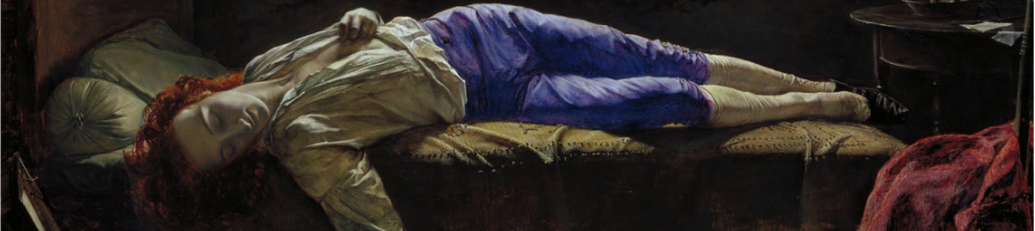
Henry Wallis, The Death of Chatterton (1856)
ROMANTICISM (1780-1865)
BORN OF: American and French Revolutions
REACTED AGAINST: Enlightenment focus on logic over feelings
Enlightenment discussions of perfect, utopian societies caused several writers to write fictional narratives centered on the joy one would feel in such a society. While some European authors (particularly the Goths) engaged in this type of writing before 1800, the movement was primarily shaped by American authors. After the American Revolution, the newly formed country was filled with writers wanting to extol the virtues of American colonists and "write the American mythology." These texts became bestsellers because, after decades of purely reasonable and objective writing, audiences craved writing that appealed to their emotions-- this became Romanticism.
Romanticism focused on the individual, as opposed to the group mindset of the Enlightenment. Romanticism eclipsed all other literature in America after the Louisiana Purchase in 1803; the new frontier and exploration led Americans to romanticize both the unknown frontier and their colonial past. The American branch of Romanticism became the first true American movement, as popular American Romantic writers were Nathaniel Hawthorne, James Fenimore Cooper, Edgar Allen Poe, and Emily Dickenson. Europe expanded on the American movement, embracing it in 1815 after the rise and fall of Napoleon, which was perceived as the failure of the Enlightenment. Popular European Romantics were Victor Hugo, William Wordsworth, Samuel Coleridge, Laurence Sterne, and William Blake.
As Romanticism dealt in an appeal to emotion, different emotional appeals became different Romantic submovements. One of the more famous movements was called GOTHIC (1764-1897), which was a European movement that appealed to fear. Gothic stories took place in Old World Europe and involved the modern man at the whim of the supernatural, which sprung out of secret historical tragedies and long forgotten places. Gothic literature mixed the thrill and fear of horror with the seduction and eloquence of romance. Popular Gothic writers include Horace Walpole, Ann Radcliffe, Mary Shelley, and Bram Stoker. American Edgar Allen Poe is also known for his Gothic stories set in Europe. Another subgenre wasTRANSCENDENTALISM (1840-1860), which was an American movement that appealed to trust. Transcendental philosophy expresses that nature is higher than reason, and the individual can “transcend” to a higher truth by spending time in nature away from the modern world. Transcendentalists embraced the environment and being free from government or social interference. Influential Transcendentalists include Ralph Waldo Emerson, Henry David Thoreau, and Walt Whitman.
Romanticism focused on the individual, as opposed to the group mindset of the Enlightenment. Romanticism eclipsed all other literature in America after the Louisiana Purchase in 1803; the new frontier and exploration led Americans to romanticize both the unknown frontier and their colonial past. The American branch of Romanticism became the first true American movement, as popular American Romantic writers were Nathaniel Hawthorne, James Fenimore Cooper, Edgar Allen Poe, and Emily Dickenson. Europe expanded on the American movement, embracing it in 1815 after the rise and fall of Napoleon, which was perceived as the failure of the Enlightenment. Popular European Romantics were Victor Hugo, William Wordsworth, Samuel Coleridge, Laurence Sterne, and William Blake.
As Romanticism dealt in an appeal to emotion, different emotional appeals became different Romantic submovements. One of the more famous movements was called GOTHIC (1764-1897), which was a European movement that appealed to fear. Gothic stories took place in Old World Europe and involved the modern man at the whim of the supernatural, which sprung out of secret historical tragedies and long forgotten places. Gothic literature mixed the thrill and fear of horror with the seduction and eloquence of romance. Popular Gothic writers include Horace Walpole, Ann Radcliffe, Mary Shelley, and Bram Stoker. American Edgar Allen Poe is also known for his Gothic stories set in Europe. Another subgenre wasTRANSCENDENTALISM (1840-1860), which was an American movement that appealed to trust. Transcendental philosophy expresses that nature is higher than reason, and the individual can “transcend” to a higher truth by spending time in nature away from the modern world. Transcendentalists embraced the environment and being free from government or social interference. Influential Transcendentalists include Ralph Waldo Emerson, Henry David Thoreau, and Walt Whitman.
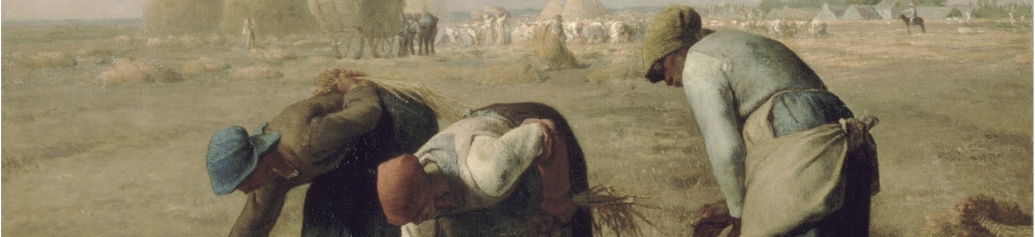
Jean-Francois Millet, The Gleaners (1857)
REALISM (1865-1918)
BORN OF: The American Civil War and Transatlantic industrialization
REACTED AGAINST: fanciful romanticizing of, well, romanticism
The brutality of the American Civil War, coupled with the spread of industrialization across American and Europe, killed the optimism and sense of beauty that drove Romanticism. Instead, writing focused on realism: writing focusing on the actual and not the fanciful. This is not to say the realism rejected beauty; realists instead found beauty in the everyday and the common. Realists depicted hardworking (often poor) modern characters faced with challenges of survival. Almost all realist works were also tragedies, or at the very least comedies where not everyone had a happy ending. Realists also delved into the psychology of characters, examining different perspective and what motivated a character's actions and beliefs. Popular American realists included Henry James, William Dean Howells, and Horatio Alger.
Like Romanticism, realism was a global literary movement and had several submovements. VICTORIAN LITERATURE (1837-1901) was an English fusion of realism and romanticism during the reign of Queen Victoria. Victorian literature was marked by the widespread development of the novel and features working-class characters interacting at some level with aristocracy. Victorian writers include Charles Dickens, William Thackeray, and Oscar Wilde. A similar movement called REGIONALISM (1850-1890) rose in the US. As a nation of various ecosystems, wide expanses of land, and multiple cultural heritages, America saw a rise to several unique communities over the 18th and 19th centuries. However, with the rise of industrialization, everything from dialects to economies were becoming standardized. Dozens of American writers responded by trying to capture the spirit and identity of these enclaves before they were homogenized and disappeared. Writers working to capturing the “unique America” included Mark Twain, Sinclair Lewis, and Kate Chopin.
Industrialization allowed a majority of people to pursue social mobility through new jobs, and this was reflected in the hero of realism: the poor character who works hard to create a better place in his or her life despite the harsh reality. NATURALISM (1893-1914) took a slightly different turn from most realism. Inspired by Darwin's theories, Naturalism still examined how harsh reality can be, but held that heredity and social status (not hard work) determined a person's character, and people are hapless victims of natural law. This movement was prominent in America with authors Stephen Crane, Jack London, and Theodore Dreiser, and in Europe with authors Thomas Hardy and Emile Zola. Another submovement created by industrialization was CLINICAL EXISTENTIALISM (1850-present). Philosophy had traditionally been community minded and centered on what is outside man, such as God or society. Yet industrialization saw the fracturing of societies and proliferation of multicultural societies without a single right answer. Philosophers founding what would become the social sciences started writing essays moving the single person is the center of philosophical meaning and focusing on the individual experience. Note that this is a nonfiction movement: existentialism became literary with the spread of modernism. Existentialists included Karl Marx, Northrop Frye, Horace Mann, and Friedrich Nietzsche.
Like Romanticism, realism was a global literary movement and had several submovements. VICTORIAN LITERATURE (1837-1901) was an English fusion of realism and romanticism during the reign of Queen Victoria. Victorian literature was marked by the widespread development of the novel and features working-class characters interacting at some level with aristocracy. Victorian writers include Charles Dickens, William Thackeray, and Oscar Wilde. A similar movement called REGIONALISM (1850-1890) rose in the US. As a nation of various ecosystems, wide expanses of land, and multiple cultural heritages, America saw a rise to several unique communities over the 18th and 19th centuries. However, with the rise of industrialization, everything from dialects to economies were becoming standardized. Dozens of American writers responded by trying to capture the spirit and identity of these enclaves before they were homogenized and disappeared. Writers working to capturing the “unique America” included Mark Twain, Sinclair Lewis, and Kate Chopin.
Industrialization allowed a majority of people to pursue social mobility through new jobs, and this was reflected in the hero of realism: the poor character who works hard to create a better place in his or her life despite the harsh reality. NATURALISM (1893-1914) took a slightly different turn from most realism. Inspired by Darwin's theories, Naturalism still examined how harsh reality can be, but held that heredity and social status (not hard work) determined a person's character, and people are hapless victims of natural law. This movement was prominent in America with authors Stephen Crane, Jack London, and Theodore Dreiser, and in Europe with authors Thomas Hardy and Emile Zola. Another submovement created by industrialization was CLINICAL EXISTENTIALISM (1850-present). Philosophy had traditionally been community minded and centered on what is outside man, such as God or society. Yet industrialization saw the fracturing of societies and proliferation of multicultural societies without a single right answer. Philosophers founding what would become the social sciences started writing essays moving the single person is the center of philosophical meaning and focusing on the individual experience. Note that this is a nonfiction movement: existentialism became literary with the spread of modernism. Existentialists included Karl Marx, Northrop Frye, Horace Mann, and Friedrich Nietzsche.
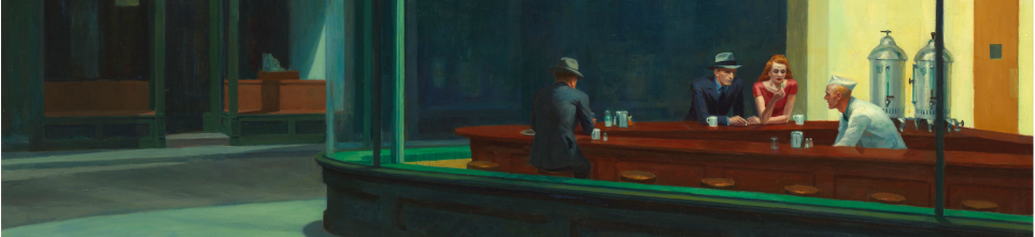
Edward Hopper, Nighthawks (1942)
MODERNISM (1900-1970s)
BORN OF: World War I and the rise of social sciences
REACTED AGAINST: Realism's stark yet firm view of an objective reality
The realist generation had grew up in close-knit communities with long-standing religious, social, and community traditions and then adapted to industrialization by moving to cities. Their children, the next generation, grew up without any of their parents' traditions and turned to realist literature for emotional anchors on how to act in the world, culminating in the idea that hard work brings reward. Then The Communist Manifesto was published and made them question social economics. And Sigmund Freud developed psychology and made them question their identity. Next, Einstein developed his theory of relativity and proved that there was no objectivity reality. Finally, World War I occurred and saw the rise of weapons that slaughtered hundreds of men in minutes. The next generation of authors was stunned: in a world without common cultural assurance in religious belief or rigid social roles, where life could be ended in an instant, what was the meaning of life?
This was modernism, an attempt to find meaning in an alienating world where all beliefs and societal foundations are relative. Modernism took ideas from the existentialists as well as the discovery of relativity (the idea that there is no absolute measure for anything). Relativity created the idea of social isolation, which was encapsulated by the ultimate Modernist image: the flaneur, where a camera captured a still person while the world moved around them. Modernism affected all art, from the isolated stark paintings of Edward Hopper to Diaghilev's Russian ballets. Many popular naturalist authors like Steinbeck and Robert Frost embraced the new movement, which believed truth came as the result of dealing with intense struggle and had the motto of "Make it new!" As Modernism was an attempt to find meaning in the world, authors created different submovements and experiments to seek different answers:
While most of modernist movement died out by the end of World War II, other modernist movements continued. For example, the Bloomsbury Group continued on into the late sixties. THE BEAT GENERATION (1945-1964) in America, for example, was a modernist reaction against materialism, conformity, and consumerism popular after World War II; beats like Jack Kerouac, William Burroughs, Alan Ginsberg, and Lenny Bruce instead called for individual freedom and a rejection of social norms in order to discover real truth. The Beats embraced and expanded upon the stream-of-consciousness techniques of the early modernists as well as embraced Harlem Renaissance jazz and surrealist art. America also had a modernist Gothic revival called SOUTHERN GOTHIC (1935-1975). Southern Gothic is sinister, magical-realist writing about the evils of poverty, alienation, and racism in the post-Civil War American South and attempts to find meaning in those suffering under the terrible legacy of slavery and the war. Southern Gothic authors included Harper Lee, William Faulkner, Margaret Mitchell, Tennessee Williams, Carson McCullers, and Eudora Welty. While modernism was declared "dead" by the 1970s, a handful of artists still follow the aesthetics of modernism; Southern Gothic has even started to return in the 2010s.
This was modernism, an attempt to find meaning in an alienating world where all beliefs and societal foundations are relative. Modernism took ideas from the existentialists as well as the discovery of relativity (the idea that there is no absolute measure for anything). Relativity created the idea of social isolation, which was encapsulated by the ultimate Modernist image: the flaneur, where a camera captured a still person while the world moved around them. Modernism affected all art, from the isolated stark paintings of Edward Hopper to Diaghilev's Russian ballets. Many popular naturalist authors like Steinbeck and Robert Frost embraced the new movement, which believed truth came as the result of dealing with intense struggle and had the motto of "Make it new!" As Modernism was an attempt to find meaning in the world, authors created different submovements and experiments to seek different answers:
- THE LOST GENERATION (1918-1930): Dozens of Modernists fought in WWI and became disillusioned with nationalism, patriotism, and regional identities. These authors sought travel as an answer to what defines humanity, hoping that existential truth was literally hidden away somewhere in the world. These authors termed themselves the Lost Generation, as they lost a generation of their peers in WWI. Lost Generation authors included Ernest Hemingway, F. Scott Fitzgerald, James Joyce, Gertrude Stein, T.S. Elliot, and John Dos Pasos.
- THE HARLEM RENAISSANCE (1919-1935): The Harlem Renaissance was a strictly African-American exploration of what it meant to be their type of human-- i.e., what is the meaning of a black American's life? Centered in the borough of Harlem, New York, these authors and artists challenged raccial stereotypes of black ignorance and lack of refinement and questioned white superiority and the broken promise of emancipation. Harlem Renaissance writers included Langston Hughes, Zora Neale Hurston, and W.E.B. Dubois.
- DADA (1913-1920): Dada was started by German artists fleeing the country at the outset of World War I. Dadaists believed that structure and rule lead to misery and the death of beauty, so their art reflected chaos and tried to offend aesthetic sensibilities. Visual art was taken over by collage, drama was mostly improvised and involved the audience, and literature would be unfinished or require the reader to finish it. Dadaists included Hugo Ball, Marcel Duchamp, Tristan Tzara, Jean Arp, Marcel Janco, Beatrice Wood, Sophie Tzuber, and Hans Richter.
- FUTURISM (1909-1920): Starting with the works of Filippo Tommaso Marinetti in Italy, Futurists believed that industrialization was the meaning of life: man was meant to craft better and better machines, with these machines solving all of our problems, including our existential crises. Futurism focused on the idea of speed as well as intuition, irony, onomatopoeia, and rhythm over grammar. Ultimately, Futurism embraced fascism and ended with the rise of Mussolini in Italy.
- SURREALISM (1924-1942): Just as Futurism began with Marinetti's "Futurist Manifesto," surrealism began with André Breton’s "Le Manifeste du Surréalisme" ("Manifesto of Surrealism"). Breton defined surrealism as "the belief in the superior reality" where "the absence of all control exerted by reason" would reveal "the true function of thought." Essentially, the surrealists believed that by violating the rules of logic that they would be able to access a superior, hidden reality. Surrealist writers like Antonin Artaud, Ren Crevel, Robert Desnos, Michel Leiris, and Benjamin Pret played with switching styles midway through a piece and non sequiter ideas to break the logic of a piece.
- BLOOMSBURY GROUP (1903-1964): The Bloomsbery Group was an association of writers who all studied together in England, including Virginia Woolf, J.M. Keyes, and E.M. Forster. The Bloomsbury writers were all wealthy but rejected the high principles and biases of the rich. They embraced art for art's sake, had open affairs and love triangles, and critiqued the colonial politics of England. Bloomsbury writing uses motifs of hypocrisy and ignorant rich characters, promotes hedonism and the pursuit of pleasure, and the promotion of feminism.
While most of modernist movement died out by the end of World War II, other modernist movements continued. For example, the Bloomsbury Group continued on into the late sixties. THE BEAT GENERATION (1945-1964) in America, for example, was a modernist reaction against materialism, conformity, and consumerism popular after World War II; beats like Jack Kerouac, William Burroughs, Alan Ginsberg, and Lenny Bruce instead called for individual freedom and a rejection of social norms in order to discover real truth. The Beats embraced and expanded upon the stream-of-consciousness techniques of the early modernists as well as embraced Harlem Renaissance jazz and surrealist art. America also had a modernist Gothic revival called SOUTHERN GOTHIC (1935-1975). Southern Gothic is sinister, magical-realist writing about the evils of poverty, alienation, and racism in the post-Civil War American South and attempts to find meaning in those suffering under the terrible legacy of slavery and the war. Southern Gothic authors included Harper Lee, William Faulkner, Margaret Mitchell, Tennessee Williams, Carson McCullers, and Eudora Welty. While modernism was declared "dead" by the 1970s, a handful of artists still follow the aesthetics of modernism; Southern Gothic has even started to return in the 2010s.
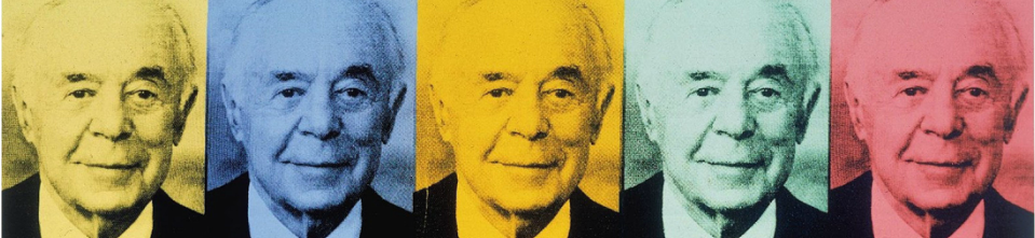
Andy Warhol, Portrait Of Seymour H. Knox (1985)
POSTMODERNISM (1940s-present)
BORN OF: World War II and the Cold War
REACTED AGAINST: Modernist insistence that life has meaning
Modernism tried multiple different avenues to try to develop a meaning and coherence to existence, hoping that such a discovery would prevent a future world war. As we all know, that didn't happen. Though some modernist endure today, World War II obliterated the goals of the modernists and the modernist aesthetic. A new generation of artists started to argue that the modernist search for the meaning of life was fruitless and that life has no meaning. This new aesthetic, called postmodernism, held that characters (and authors) were insignificant, that a character's success in dependent upon luck and chance, and that all other conflicts pale to the conflict of the man who realizes his life has no significance. A common idea of postmodern works is absurdity, which is the principle that even the best logic breaks down in practice. In modernism, whatever is not expected happens (also known as irony), plans always go awry, and the most absurd and unsuccessful characters are the ones to win in the end. Postmodernism upended the idea of post-structuralist binaries like man-woman, good-evil, and true-false by showing the futility of categorization and faith in taxonomy. Postmodernism also employs pastiche in order to show that authors of the past were just as clueless about life as authors now. Some of the best postmodern writers are Kurt Vonnegut, Joseph Heller, Don DeLillo, and Jorge Luis Borges.
As postmoderism embraced ironic rebellion, it had several submovements centered around different types of rebellions. A similar gripe was held by the writers of NEW JOURNALISM (1960-1990), who hated how dry an manufactured the news was. Thus, journalists like Thomas Wolfe, Truman Capote, Norman Mailer, and Hunter S. Thompson used literary techniques to make factually true narratives seem untrue.
Yet Americans weren't the only ones rebelling. Britain saw the rise of the ANGRY YOUNG MEN (1957-1975), who were working class British male authors rebelling against British aristocracy and gentility by exposing the beauty of anarchy and social alienation. John Osborne, Harold Pinter, Arnold Wesker, and Anthony Burgess were all Angry Young Men. Meanwhile, the French had the NOUVEAU ROMAN (1955-1970) movement, which rebelled against the structure of narrative itself. Writers like Georges Perec and Marguerite Duras wrote books without cohesive plot, conflict, character development, tension, or even complete thoughts. The Nouveau Romans wanted every text to have its own style, never to be repeated; these artist inspired American IMAGE FICTION (1980-present), which attempts to take common items and images and make them unrecognizable and absurd (popular image fiction writers are Chuck Palahniuk and David Fincher).
Another more global rebellion was the development of postcolonial literature, which was written by natives of former Western colonies in the Americas, Africa, and several island nations. The goal of postcolonialism is to break with Western styles of writing instituted by colonizes and rediscover their culture’s own voice. One postcolonial attempt by Latin American authors is called TESTIMONIO (1940-present). Testimonio rebels against traditional literature by blurring the line between truth and fiction by mixing magical realism with examinations of the how the political world is inseparable from the domestic sphere. Great writers of Testimonio include Gabriel Garcia Marquez, Achy Obejas, Mario Vargas Llosa, and Julia Alverez.
As postmoderism embraced ironic rebellion, it had several submovements centered around different types of rebellions. A similar gripe was held by the writers of NEW JOURNALISM (1960-1990), who hated how dry an manufactured the news was. Thus, journalists like Thomas Wolfe, Truman Capote, Norman Mailer, and Hunter S. Thompson used literary techniques to make factually true narratives seem untrue.
Yet Americans weren't the only ones rebelling. Britain saw the rise of the ANGRY YOUNG MEN (1957-1975), who were working class British male authors rebelling against British aristocracy and gentility by exposing the beauty of anarchy and social alienation. John Osborne, Harold Pinter, Arnold Wesker, and Anthony Burgess were all Angry Young Men. Meanwhile, the French had the NOUVEAU ROMAN (1955-1970) movement, which rebelled against the structure of narrative itself. Writers like Georges Perec and Marguerite Duras wrote books without cohesive plot, conflict, character development, tension, or even complete thoughts. The Nouveau Romans wanted every text to have its own style, never to be repeated; these artist inspired American IMAGE FICTION (1980-present), which attempts to take common items and images and make them unrecognizable and absurd (popular image fiction writers are Chuck Palahniuk and David Fincher).
Another more global rebellion was the development of postcolonial literature, which was written by natives of former Western colonies in the Americas, Africa, and several island nations. The goal of postcolonialism is to break with Western styles of writing instituted by colonizes and rediscover their culture’s own voice. One postcolonial attempt by Latin American authors is called TESTIMONIO (1940-present). Testimonio rebels against traditional literature by blurring the line between truth and fiction by mixing magical realism with examinations of the how the political world is inseparable from the domestic sphere. Great writers of Testimonio include Gabriel Garcia Marquez, Achy Obejas, Mario Vargas Llosa, and Julia Alverez.

Paul Harvey, Girl and Olive Tree (2011)
NEW SINCERITY (1990-present)
BORN OF: The rise of the internet age and rise of terrorism
REACTS AGAINST: Postmodern irony and absurdity
New Sincerity began with personal blogs in the mid-1990s. Pages cropped up celebrating all matter of icon and celebrity, and a growing Hipster movement (a product of Postmodernism) praised the most unpopular or kitschy pages in an ironic and laughable way. This attitude did not sit well with the page authors, who legitimately enjoyed subjects like daredevil Evel Knieval and animated 1980s cartoon The Snorks. A movement of these writers coalesced as the antithesis of Postmodernism-- writers who attempt to create texts with personal meaning and honesty and without irony, apology, or cynicism. One of these writers, David Foster Wallace, coined this movement "New Sincerity:"
“The next real literary “rebels” in this country might well emerge as some weird bunch of anti-rebels, born oglers who dare somehow to back away from ironic watching, who have the childish gall actually to endorse and instantiate single-entendre principles. Who treat of plain old untrendy human troubles and emotions in U.S. life with reverence and conviction... These anti-rebels would be outdated, of course, before they even started. Dead on the page. Too sincere [. . .]
Maybe that’ll be the point. Maybe that’s why they’ll be the next real rebels. Real rebels, as far as I can see, risk disapproval. The old postmodern insurgents risked the gasp and squeal: shock, disgust, outrage, censorship, accusations of socialism, anarchism, nihilism. Today’s risks are different. The new rebels might be artists willing to risk the yawn, the rolled eyes, the cool smile, the nudged ribs [. . .] To risk accusations of sentimentality, melodrama. Of overcredulity. Of softness. Of willingness to be suckered by a world of lurkers and starers who fear gaze and ridicule above imprisonment without law.”
-- David Foster Wallace, "E Unibus Pluram: Television and U.S. Fiction"
In the essay quoted above, David Foster Wallace coined this new movement of rebels against irony "The New Sincerity:" New Sincerity began with personal blogs in the mid-1990s. Webpages cropped up celebrating all matter of icon and celebrity, and the postmodern hipsters praised the most unpopular or kitschy pages in an ironic and laughable way. This attitude did not sit well with the page authors, who legitimately enjoyed subjects like daredevil Evel Knieval and animated 1980s cartoon The Snorks. A movement of these writers are starting to coalesce into the antithesis of Postmodernism. Instead of embracing irony and hypocrisy, these authors embrace paradox, or the ability for two contradictory ideas to both be true. Instead of cynicism about the intentions of others, these authors embrace optimism. Instead of apathy, these authors have such sentimentality that they would prefer nativity (a lack of wisdom or judgement) over detachment. While modernism sought to discover truth and meaning and postmodernism claimed that there was no truth or meaning to the world, New Sincerity announces loudly that the meaning of life is the relationships we build and how the things we love make our life meaningful. And while New Sincerity sympathizes with those enduring struggle, it doesn't dwell on an individual's victimhood but tells marginalized groups that they can beat the odds.
The zeitgeist of New sincerity was explored through several submovements in the 1990s and 2000s. Lars von Trier and other Scandinavian artists pioneers the DOGME 85 style (1995-present), which demanded that all art be set in the present here and now and done simply to bring beauty to the world (many artists in this movement refused to be credited for their work, believing the art to be a separate and complete entity). A similar movement in America led rise to the NEW PURITANS (2000-present), a submovement that values narrative convention over everything else. New Puritan works strictly respect genre conventions, use no figurative language, and use simple and straightforward grammatical constructions. Believing that every written work is a historical document, New Puritans only use the names of real places and products and base fictional characters off real people that exist. They also tell stories linearly without any flashbacks or foreshadowing. The philosophy of REMODERNISM (2000-present), which calls for a return of authenticity and autonomy to an author's work and rejects multimedia complexity, also contributed heavily to the ideas of New Sincerity. Remodernism is also called post-postmodernism, transmodernism, and post-millennialism. In art, remodernism influenced two separate movements: kitsch and stuckism. KITSCH (1998-present) first appeared in the 1930s and was known as the opposite of avant garde (i.e., radically rebellious) art, but has now become an artistic revival of conforming to classical techniques (use of a vanishing point, realistic brushstrokes, etc) of modern figures and places. STUCKISM (1999-present) uses modern techniques, such as the cartooning lines of Lichtenstein and clashing color combinations of Warhol, but requires all art to be hand-painted and refuses mass production. Each painting is to be as minimalist as possible, one of a kind (paintings are never reproduced as prints except for text anthologies), and should evoke a sense of beauty and higher meaning.
From these early experiments, New Sincerity as a whole picked up momentum after the World Trade Center attacks in 2001, when shows of sorrow and patriotism were not only genuine but lacked ironic critique. More individuals are trying to seek wholesome experiences and are seeking stories that encourage traditional values such as working hard, self-reliance, and trusting others (which explains why those in the New Sincerity are drawn to Romanticism). But don't think that New Sincerity is all lovey-dovey: those who embrace New Sincerity are the same individuals protesting at Occupy Wall Street and the Women's March on Washington, as they are sincere enough to stand up for what they believe in. New Sincerity is also behind the push for nostalgia and the recent embrace of comic book films, as New Sincerity is about celebrating personal joy and perspective without trying to promote or reject a differing point of view. This last element is important: while New Sincerity is focused on universal tolerance and a "live and let live" attiude, its members quickly acknowledge that their ultimate enemy is the Hate Group, which is any cynical organization that seeks to harm and oppress others but seeks safety under ironic victimhood. New Sincere artists like Wallace, Kevin Smith, Zadie Smith, Michael Chabon, Dave Eggers, and Jonathan Franzen seek to instead expose corruption and false intentions and seek to build relationships with people whose hate is genuine in order to change their minds. Since this movement is still emerging and it can be hard to determine just how it differs from modernism and postmodernism, I've broken down the major differences in an article linked below.
Related to New Sincerity is the rise of creative nonfiction. In the Information Age, where more news comes from Twitter feeds than expose novels, nonfiction has taken on a narrative tone to gather interest. Creative nonfiction focuses on personal narratives, usually in the form of autobiographies; yet unlike autobiographies of the past, these stories incorporate interweave facts, statistics, and objective perspectives like a journalistic piece. The writers of these piece are heavy in New Sincerity, as they are sincerely interested and engaged by statistics and subject that traditionally seem boring. Creative nonfictive authors include Oliver Sachs, Augusten Burroughs, Mary Roach, and David Sedaris.
The zeitgeist of New sincerity was explored through several submovements in the 1990s and 2000s. Lars von Trier and other Scandinavian artists pioneers the DOGME 85 style (1995-present), which demanded that all art be set in the present here and now and done simply to bring beauty to the world (many artists in this movement refused to be credited for their work, believing the art to be a separate and complete entity). A similar movement in America led rise to the NEW PURITANS (2000-present), a submovement that values narrative convention over everything else. New Puritan works strictly respect genre conventions, use no figurative language, and use simple and straightforward grammatical constructions. Believing that every written work is a historical document, New Puritans only use the names of real places and products and base fictional characters off real people that exist. They also tell stories linearly without any flashbacks or foreshadowing. The philosophy of REMODERNISM (2000-present), which calls for a return of authenticity and autonomy to an author's work and rejects multimedia complexity, also contributed heavily to the ideas of New Sincerity. Remodernism is also called post-postmodernism, transmodernism, and post-millennialism. In art, remodernism influenced two separate movements: kitsch and stuckism. KITSCH (1998-present) first appeared in the 1930s and was known as the opposite of avant garde (i.e., radically rebellious) art, but has now become an artistic revival of conforming to classical techniques (use of a vanishing point, realistic brushstrokes, etc) of modern figures and places. STUCKISM (1999-present) uses modern techniques, such as the cartooning lines of Lichtenstein and clashing color combinations of Warhol, but requires all art to be hand-painted and refuses mass production. Each painting is to be as minimalist as possible, one of a kind (paintings are never reproduced as prints except for text anthologies), and should evoke a sense of beauty and higher meaning.
From these early experiments, New Sincerity as a whole picked up momentum after the World Trade Center attacks in 2001, when shows of sorrow and patriotism were not only genuine but lacked ironic critique. More individuals are trying to seek wholesome experiences and are seeking stories that encourage traditional values such as working hard, self-reliance, and trusting others (which explains why those in the New Sincerity are drawn to Romanticism). But don't think that New Sincerity is all lovey-dovey: those who embrace New Sincerity are the same individuals protesting at Occupy Wall Street and the Women's March on Washington, as they are sincere enough to stand up for what they believe in. New Sincerity is also behind the push for nostalgia and the recent embrace of comic book films, as New Sincerity is about celebrating personal joy and perspective without trying to promote or reject a differing point of view. This last element is important: while New Sincerity is focused on universal tolerance and a "live and let live" attiude, its members quickly acknowledge that their ultimate enemy is the Hate Group, which is any cynical organization that seeks to harm and oppress others but seeks safety under ironic victimhood. New Sincere artists like Wallace, Kevin Smith, Zadie Smith, Michael Chabon, Dave Eggers, and Jonathan Franzen seek to instead expose corruption and false intentions and seek to build relationships with people whose hate is genuine in order to change their minds. Since this movement is still emerging and it can be hard to determine just how it differs from modernism and postmodernism, I've broken down the major differences in an article linked below.
Related to New Sincerity is the rise of creative nonfiction. In the Information Age, where more news comes from Twitter feeds than expose novels, nonfiction has taken on a narrative tone to gather interest. Creative nonfiction focuses on personal narratives, usually in the form of autobiographies; yet unlike autobiographies of the past, these stories incorporate interweave facts, statistics, and objective perspectives like a journalistic piece. The writers of these piece are heavy in New Sincerity, as they are sincerely interested and engaged by statistics and subject that traditionally seem boring. Creative nonfictive authors include Oliver Sachs, Augusten Burroughs, Mary Roach, and David Sedaris.